
How Peter Frampton Changed Tom Morello’s Life
I profiled Frampton for The New York Times. This great little chat with Morello—about Frampton’s influence and his burgeoning politics, at 76—happened just after I filed the piece.

First up, an apology. This is the first newsletter I’ve sent in five weeks, despite the goal of sending at least one a week. Work and life have been insanely busy, and the deadlines others set for me have simply superseded the deadlines I set for myself here. I know some of you have elected to pay for this newsletter (which is completely optional, but also, thank you so much), and if you’d like me to refund you for the last month, send me a note, and I’ll be happy to do it. I’ll try not to be so slow again.
Anyway, lots of links for you to recent work. Here’s a Pitchfork profile of Jeff Parker, plus Pitchfork reviews of the new Black Keys album (nah) and the debut of a 53-year-old Greek priest (hell yeah). I have a profile of Paul McCartney in the new MOJO, which you can order here, and I controversially profiled a Pacific Crest Trail hiker named Kamryn Renae at Outside. But the one I really want to mention at the moment is Peter Frampton, who I profiled for The New York Times in advance of his very good album, Carry the Light, which came out last Friday. Thanks for reading Out + Back, and back to you early next week.
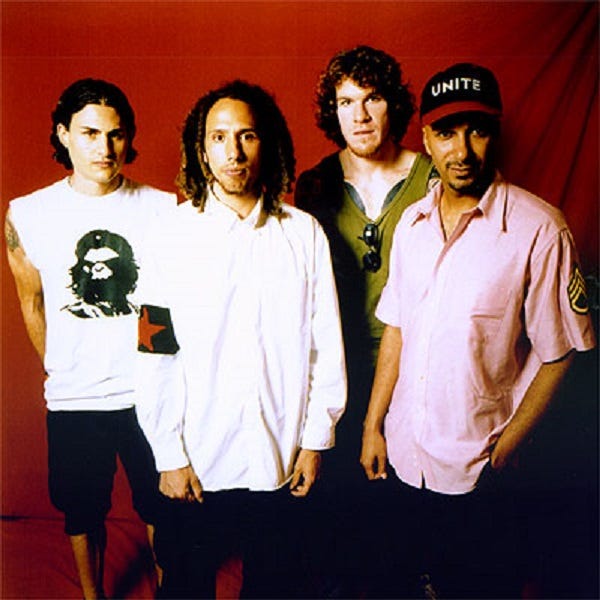
When I was 15 and a lifetime seemed much more limitless, I had an after-school ritual: Each day, I would sit on the carpet in front of an oversized TV in my family’s living room and watch Rage Against the Machine, a composite concert film the band had released two years earlier. I was a country kid whose live music experience at that point was limited to watching Ben Folds Five or Vertical Horizon or whatever play the summer radio-station jamboree at an amphitheater an hour away. Watching a mosh pit every day on a DVD was akin to watching footage of the lunar landing—totally alien, so far outside of my lived purview I could not believe anyone had ever actually experienced such a thing.
In thinking about writing this little entry, I read Entertainment Weekly’s review of that disc and winced at this myopic joke: “Armchair headbangers rejoice … experience RATM’s galvanic rap-metal fusion without suffering the indignities of a mosh pit.” Cool, man, but some of us were country kids without a car, and this is simply the closest we could get. That footage was a billboard, letting me know how wild the world could be.
Perhaps, then, you can imagine my gasp when I picked up my phone three weeks ago and spotted the following text: “Morello here. U free?” I’d been trying to track down the Rage guitarist for several days, hoping to ask him about his contribution to Carry the Light, the charming and stirring new album from Peter Frampton, who I was profiling for The New York Times. But Morello was on the road as part of Bruce Springsteen’s current band, so he’d been busy.
His text arrived an hour after I filed the piece. I called him back and told him that I’d try to shoehorn his thoughts about Frampton into an edit, but I wasn’t sure it would work, meaning his words might wind up here, on Substack. As the rest of the E Street Band soundchecked within earshot, he said he didn’t mind: He simply wanted to talk about a guy whose music had changed his life. Turns out, Frampton for Morello had been a little bit like Rage for me: a transformative after-school standby. Here’s the very brief and very fun exchange I had with Morello about Frampton, just before he played the United Center with Springsteen.
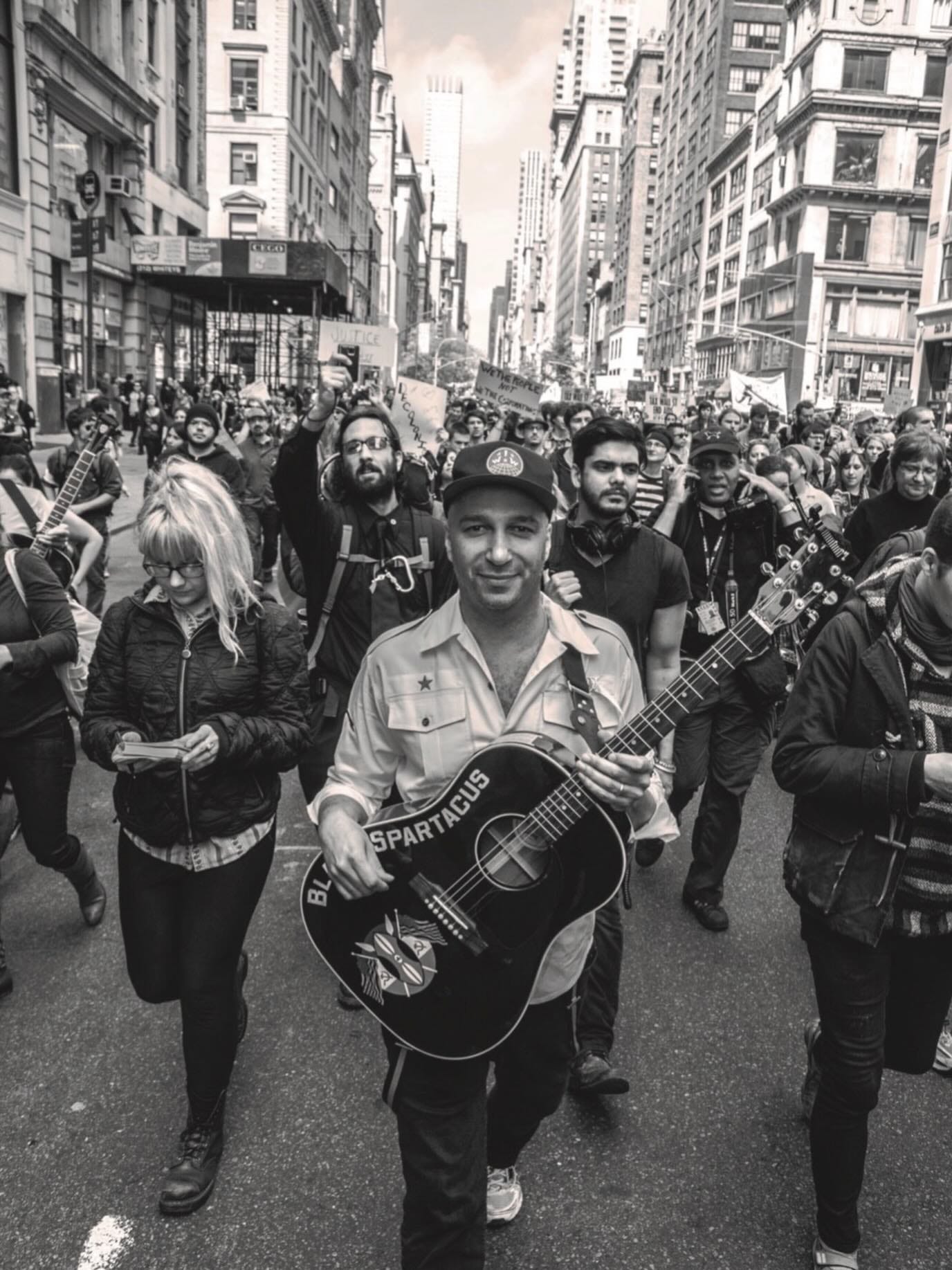
Let me start with a basic question: When did you first hear Peter Frampton?
I was swept up with the rest of the world in the Frampton Comes Alive! frenzy. I had that record. I loved that record. I wore that record out, like me and 25 million others. [Laughs]
What did you like so much about it?
As a young man who loved hard rock and metal, it was a record that had enough guitar power for me, enough blazing guitar solos and creative guitar solos. But it also had a songwriting sophistication and vibe and melodic sense that I also connected with.
It was also the era of live albums. Kiss Alive! was my record. The Deep Purple live record [presumably Made in Japan] was my record. So it fit. To be perfectly clear, it is a great record, but it is anchored by one of the all-time great live captures, and that is “Do You Feel Like We Do.” I’ve had the pleasure of telling Peter Frampton this story, and he found it hard to believe. I swear that it is true. There’s an arrangement trick that he does in “Do You Feel Like We Do” that I lifted for Rage Against the Machine. And it’s basically where there’s a long breakdown where the rock power goes away, the title of the song is said over and over again, then it comes crashing in with a completely monstrous rock power that raises the hairs on your arms and makes you want to jump around the room. Well, that’s the formula for pretty much every Rage Against the Machine song.
I was sitting here thinking, “I’m going to ask Tom which song,” but I can think of at least six where that might apply.
Exactly. Exactly. That was when that first occurred to me—you go quiet, then you say the name of the song a bunch of times, you come in really hard, and it’s awesome. [Laughs]
It’s also not lost on me that, on that record, Peter’s guitar playing is unique, likely something that triggers a kid’s imagination.
That’s right. That definitely, literally, spoke to me; I put “spoke” in quotation marks, because no one knew what was even happening. All of a sudden, there’s a fellow who is talking—and playing guitar simultaneously. It was a total mystery, in line with some of the great mind-bending rock mysteries of the day. Like there was a guy in one band breathing fire. There was a guy in another band playing with a violin bow. Then there was a guy who was talking the song but also shredding at the same time? It was absolutely mind-blowing, and no one had any idea how he was doing it.
When’s the first time you met?
I didn’t meet Peter Frampton until much later on, maybe five or six years ago, backstage somewhere. I found him to tell him these stories that I just told you. [Laughs] And about my appreciation for him as an artist, a guitar player, and as someone whose music was very foundational for me in the way that I thought about songwriting or making excitement occur in music.
After Frampton Comes Alive!, there’s a very long period in the wilderness for Peter, albums that he admits didn’t quite fulfill the promise. Did you follow along? Did you wonder what had happened?
I didn’t keep that much track, but I will say he followed up “Do You Feel Like We Do” with “I’m in You.” [Laughs] And for those of us who were on the Black Sabbath, AC/DC tip at the time, the barometer had moved for us. Then there was punk rock and hip-hop. So it wasn’t really on my radar, but I always had a fondness for that. I still have my vinyl from ‘76, which I occasionally put on, the “Do You Feel Like We Do” side, and remember how revelatory it was.
On Peter’s new record, you’re on a song called “Lions at the Gate,” which is one of several political tracks on the record. That’s a long way from “I’m in You.” Peter is 76, and, for him, it seems to be a question of, if not now, when?
Absolutely. I happen to be on tour with another 76-year-old who is trying to move the political meter. I think it just speaks to the dangerous nature of the times and to artists with a heart and a soul trying to use the cultural capital they have to do what they can while they can. I certainly see that with Peter. When he reached out about this song, it was a real honor. The crazy full circle moment of leaping around in my bedroom to singing along in the car to being in my studio playing on a song with Peter: It’s not one of those dream-come-true moments, because it’s something I would have never dared to dream.
I just love the fact that, first of all, Peter is a lovely person. They say, “Don’t meet your idols.” Well, you can meet Peter Frampton. [Laughs] He’s just a great dude, and the fact that he’s applying what he has to move the meter, it’s an honor to help support him in that effort.
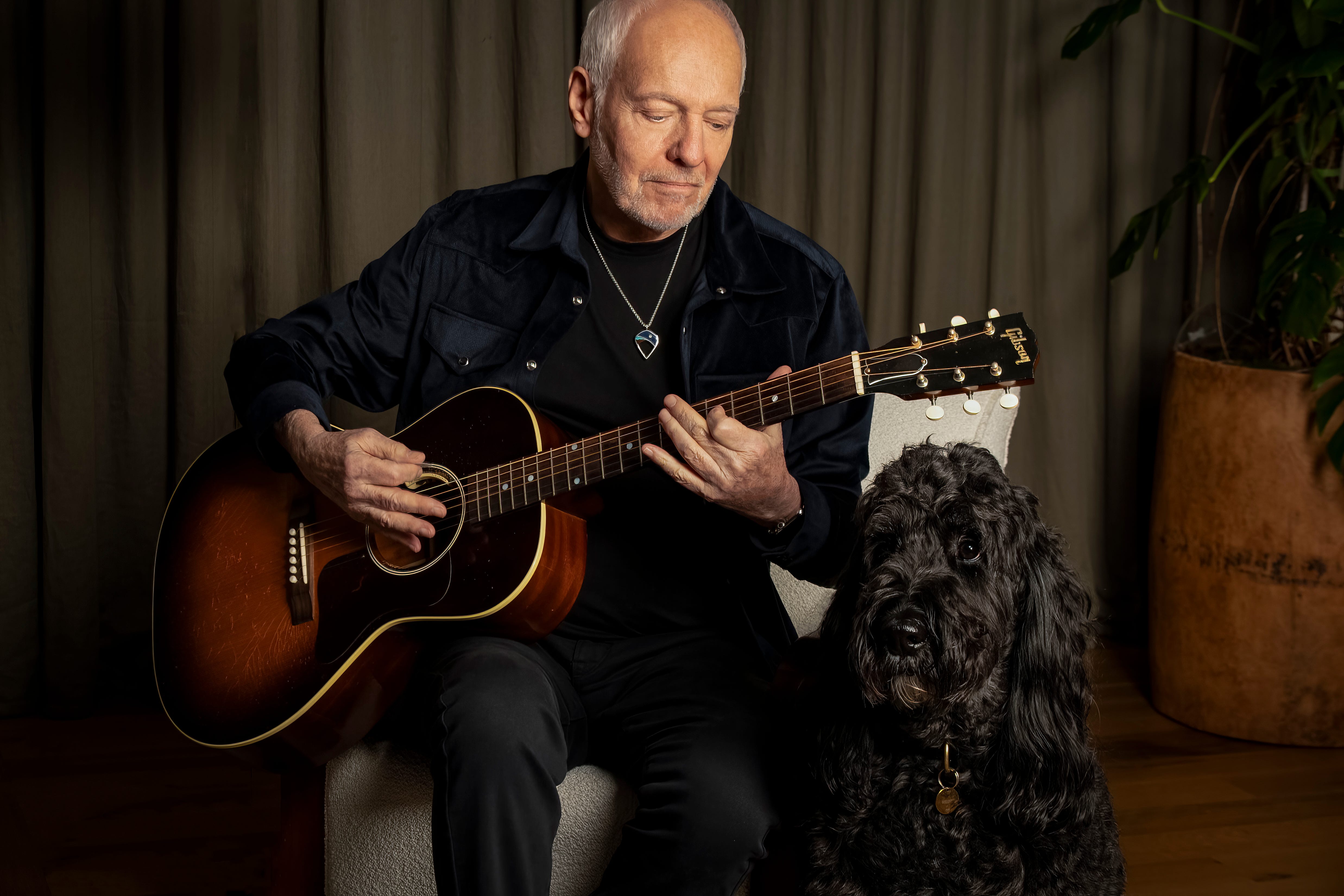
Did Peter preface the song by saying, “It’s political”? Or did you hear it and think, “What the fuck is Peter Frampton doing?”
He prefaced it by saying he was responding to the times. And that doesn’t necessarily mean that a song’s gonna be good. [Laughs] You know what I mean? But I thought it was great. He was really applying the best of Peter Frampton—his singing, songwriting, guitar-playing essence, in a song that’s timely and nuanced and poetic. And it’s a great Peter Frampton song, and I’m honored to be a part of it. I will say, before I forget, I’m on the nominating committee for the Rock & Roll Hall of Fame, and he’s one of the ones we’ve been lobbying for for years. I don’t think he gets credit for his foundational importance in a lot of conversations. The way that it affected me was Rock & Roll Hall of Fame-worthy.
I should let you run. You have a show to play. Thanks for calling.
I gotta go eat some food and rock the United Center right now.
Very nice little bonus after reading your excellent Frampton piece in the NYT.
So interesting that Frampton would have inspired someone like Tom Morello. Thanks for this insight.